Sessions don't track margin
MPP sessions stream micropayments but never reconcile cost vs. revenue. You see spend, not profit.
Stripe's Machine Payments Protocol is OAuth for money. But OAuth doesn't give you a P&L. StringCost adds credits, double-entry ledgers, usage caps, and chargebacks on top of every MPP session.
Trusted by YC and a16z-backed teams
Stripe calls MPP “OAuth for money.” But OAuth doesn't give you a general ledger. The moment you meter real agent workloads, payment alone breaks down.
MPP sessions stream micropayments but never reconcile cost vs. revenue. You see spend, not profit.
GPT-4 tokens, Claude tokens, vector DB queries — MPP records each payment separately with no unified cost basis.
Thousands of micro-transactions aggregate into a single settlement. Which agent run drove which cost?
MPP settles payments via Stripe. StringCost sits in front of your agent traffic as a proxy — metering the full workflow, computing the ledger, and settling the exact amount across stablecoins and fiat.
Finally answer: “What's the P&L of each MPP session?”
Set a max, stream usage, capture only what was consumed. Dynamic ceilings, not static session caps.
Package usage into credits with discounts and flexible terms. MPP has no native credit system.
Every tool call becomes a debit and credit. Margin is visible per run, per agent, per customer.
Per-user, per-agent, per-org limits. MPP session caps are a single number, not a policy engine.
Failed runs reversed cleanly with full audit trail. MPP refunds are manual Stripe Dashboard operations.
Unified cost basis across stablecoins, fiat SPTs, and all providers. One ledger for everything.
MPP sessions commit funds upfront with a single cap. StringCost adds a full credit system on top — prepaid balances, volume discounts, postpaid invoicing, and dynamic limits that adjust in real time.
Micro
$0.01
USDC on Tempo
Macro
$10,000
Multi-agent workflow
Same accounting backbone handles stablecoins and fiat SPTs — no prefunded wallet required.
Agent maps to organization with credit policies and spending ceilings
StringCost catches the challenge before payment executes
StringCost draws from prepaid balance, opens double-entry ledger
Stablecoins or fiat SPTs flow through Stripe as normal
Close the run, return unused credit, reconcile the books
Stripe's MPP handles the payment. But payments don't replace accounting.
StringCost is a runtime-aware proxy — not a library that invades your code. It inspects agent traffic at the network level via a secure, signed-URL architecture.
Your app asks the Control Plane for permission to make a call. No static API keys — ever.
The Control Plane returns a short-lived, single-use signed URL with encrypted credentials. Key leakage is impossible.
Your agent calls the Gateway with this URL. We validate the signature, check for replay attacks, proxy the call, and record every action to the ledger.
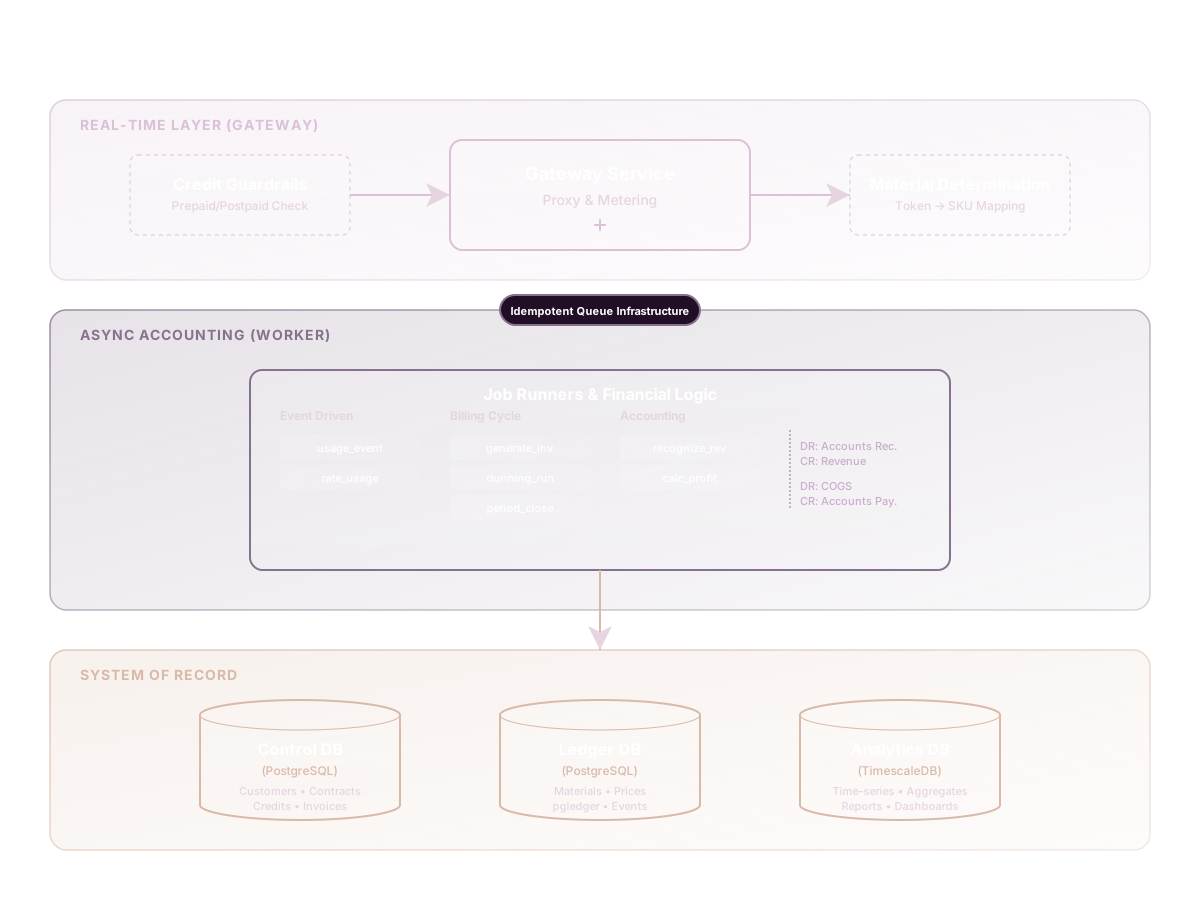
Every request flows through an asynchronous deep prompt inspection engine. A background worker polls every 200ms, calling a meta-classifier to tag each request with an action type — synthesis, tool_selection, evaluation — with zero added latency.
Every computational action — LLM calls, tool invocations, MPP micropayments — becomes a distinct line item with two sides:
The result: an auditable, real-time P&L for every MPP session. Which agents are most profitable? Which tools drive the most cost? What's your true AI margin?
MPP returns a 402 challenge. StringCost turns that into a metered session with real-time cost attribution across every provider.
Server returns HTTP 402 challenge. StringCost intercepts before payment executes.
Authorization ceiling set, signed session issued, double-entry ledger started.
Each token, tool call, and compute step recorded as a line item with cost and revenue.
MPP settles the payment. StringCost captures the exact amount, refunds the delta, closes the books.
Proxy accounting, credits, and settlements in one stack. Built for usage-based AI — across stablecoins and fiat.