OLD
Traditional SaaS
Predictable per-seat cost
$20/seat/month, same every month. Budget once, forget about it.
Static utilization
Every seat costs the same regardless of usage.
StringCost gives enterprises an OpenShell-based runtime for coding agents and a proxy deployed in the customer environment.
Every model call, tool call, and CLI session flows through that proxy, while the managed control plane handles policy, reporting, and governance.
15 min
Detection window
250x
Variance between users
$1,500
Weekend runaway session
Live proxy snapshot
Spend control before the invoice exists
Proxy event
Agent loop exceeded baseline by 18x
Paused after 15 minutes with repo mapping and chargeback preserved.
Today
$482.70
Flagged
03
Protected
$1.2k
The first enterprise rollout should feel normal for developers and controlled for platform, security, and finance.
Rollout state
Live policyClaude-ready boundary
Container, proxy, and ledger aligned before broad adoption.
01
Contain
Claude Code runs in an OpenShell-based container instead of directly on laptops with SSH keys, cloud credentials, and production env files.
02
Route
Model calls, tool calls, and CLI sessions exit through a customer-prem StringCost proxy before they become vendor spend.
03
Govern
The managed plane maps usage to user, repo, team, and cost center, then applies limits, alerts, and chargeback.
Developer
Normal Claude CLI workflow
Platform
Egress and key controls
Finance
Live spend by owner, repo, vendor
The result: developers can start with Claude Code, while enterprise controls exist before usage becomes a procurement surprise.
AI coding tools moved cost from flat seats to live execution. Agent loops, CLI sessions, and tool calls now create spend before a vendor invoice exists.
Predictable per-seat cost
$20/seat/month, same every month. Budget once, forget about it.
Static utilization
Every seat costs the same regardless of usage.
Volatile per-token cost
A single runtime loop can 10x your bill before anyone sees the invoice.
Dynamic consumption
Power users, CLIs, and tool retries can cost 50x more than light users.
250x
Cost variance between users
$1,500
Single runaway agent session
15 min
StringCost detection time
Modern agents package work as shell commands, generated code, and tool calls. Run them inside an OpenShell-based runtime, route egress through a StringCost proxy in your environment, and the managed control plane gets the budget, attribution, and audit trail.
“Y Combinator's CEO says he ships 37,000 lines of AI code per day. A developer looked under the hood.”
When one developer can ship that much AI-generated code, the real meter is runtime execution, not seat count. Without a proxy on that path, the extra velocity turns straight into uncapped token burn and runaway invoices.
Y Combinator CEO
“I'm working on 3 different big projects simultaneously across 15 sessions all the time. In the last 7 days I'm averaging 17k lines of code per day, 35% tests.”
Fifteen concurrent sessions means fifteen live cost surfaces. The control point is the runtime and proxy boundary, not the invoice artifact at month-end.
78% of IT leaders report unexpected charges from AI consumption tiers. The flat-rate SaaS budget is a myth in the age of LLM inference.
OpenClaw (60K+ GitHub stars) proves the point. It isn't an assistant that happens to code. It's a coding agent that happens to assist. Built on Pi's philosophy: only 4 core tools (Read, Write, Edit, Bash). Everything else is generated code. Agents write their own skills as Markdown files, hot-reloaded in 250ms. Extension through code generation, not protocol integration, and every extension burns tokens.
Each AI tool provides a different level of visibility and control. StringCost fills the gaps across all of them.
StringCost unifies all three into a single pane of glass with real-time attribution, anomaly detection, and automated chargebacks.
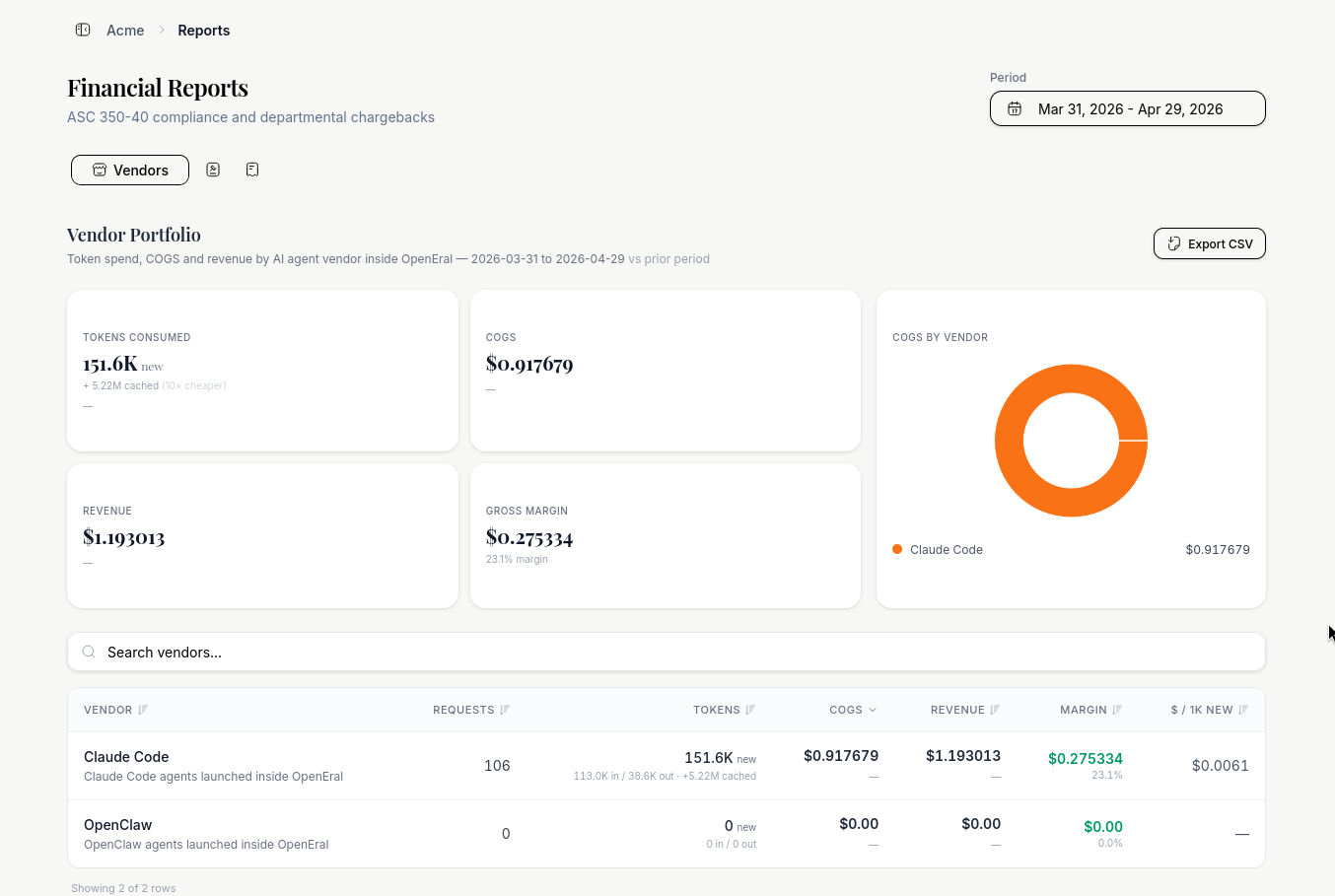
StringCost gives you the control layer between developer-tool velocity and financial exposure: user-level tracking, project-level attribution, anomaly detection, and budget enforcement in one system.